

Overview
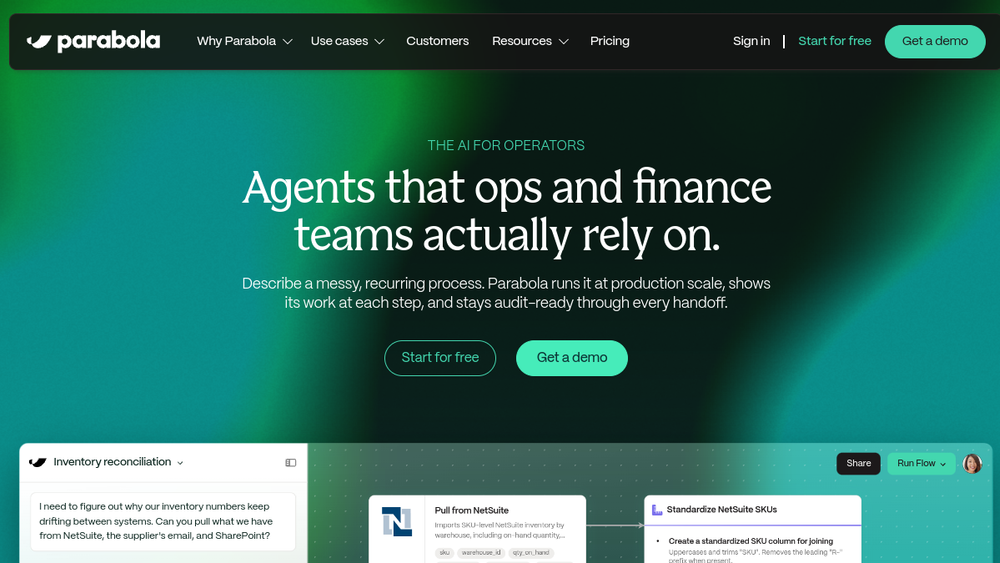
Parabola is an AI agent platform designed for operations and finance teams. It allows users to describe a messy, recurring process in plain language, and Parabola builds an automated agent that runs it at production scale. The platform emphasizes transparency and auditability, showing its work at each step and maintaining a clear record for compliance.
Parabola fits into the broader automation and no-code space by combining AI-driven workflow creation with visual, editable logic. It is positioned for high-stakes business processes where generic AI tools fall short, such as inventory reconciliation, invoice auditing, and revenue reporting. The platform connects to existing tools, schedules runs, and provides dashboards and reports, making it a comprehensive solution for operational teams.
Best for
- Operations teams that need to automate complex, recurring workflows involving multiple data sources.
- Finance teams that require audit-ready processes for tasks like invoice auditing and accrual reporting.
- Teams looking for a no-code solution that allows non-technical staff to build and maintain automations.
- Organizations that need transparent AI decision-making with full documentation for compliance.
- Businesses that want to move from manual, spreadsheet-based processes to automated, scalable workflows.
Key capabilities
- Natural language process description: Users describe a process as they would to a colleague, and Parabola asks follow-up questions to build the agent.
- Visual, editable workflow: The resulting process is a visual agent that can be edited, with changes propagating downstream automatically.
- Step-level transparency: Every step shows its input, logic, and output, with AI reasoning explained in plain language.
- Integration with 1,000+ data sources: Connects to ERP, data warehouses, email, file storage, and more.
- Scheduled and triggered runs: Agents can run hourly, daily, weekly, or on triggers, with retries and failure alerts.
- Dynamic reporting: Tables can be turned into charts, dashboards, or reports that update automatically with data changes.
Common workflows
- Inventory reconciliation: Pull inventory data from NetSuite, supplier emails, and SharePoint, standardize SKUs, compare quantities, and flag discrepancies.
- Carrier invoice auditing: Automatically audit DHL, UPS, and other carrier invoices against rate cards to catch overcharges before payment.
- Sales channel consolidation: Combine sales data from Shopify, Amazon, retail, and wholesale into a single normalized table for revenue analysis.
- KPI reporting: Generate executive-level dashboards and reports that update automatically, reducing manual reporting time.
- Exception handling: Monitor shipments or orders for issues like late deliveries or duplicate shipments, and trigger alerts or recovery workflows.
What to evaluate
- Integration coverage: Assess whether Parabola connects to the specific systems your team uses, such as ERP, CRM, or data warehouses.
- Ease of building and maintaining workflows: Consider how intuitive the natural language interface is and how easy it is to edit workflows as processes change.
- Error handling and observability: Evaluate how Parabola handles failures, retries, and alerts, and whether the audit trail meets your compliance needs.
- Team adoption and permissions: Check if role-based access and sharing features align with your team's structure and security requirements.
- Scalability and performance: Consider how the platform handles large data volumes and frequent runs, especially if you process millions of rows.
Getting started
- Describe your process: Start by typing a description of the messy, recurring process you want to automate, as if explaining it to a colleague.
- Review and refine the agent: Parabola will generate a visual workflow; review each step, adjust logic as needed, and ensure it matches your requirements.
- Connect data sources and run: Connect your systems, set a schedule or trigger, and run the agent. Monitor the output and iterate on the workflow as needed.
Why ToolSift lists it
Parabola is listed under Automation and Business because it provides a no-code platform for automating complex operational workflows, which is a core need for modern businesses. The tags Workflow Automation, Integrations, No-Code, and Business Tools accurately reflect its functionality and target audience. We verified the official URL at https://parabola.io, and the page title and meta description align with the product's positioning. For more information, visit Parabola's official website.

