

Overview
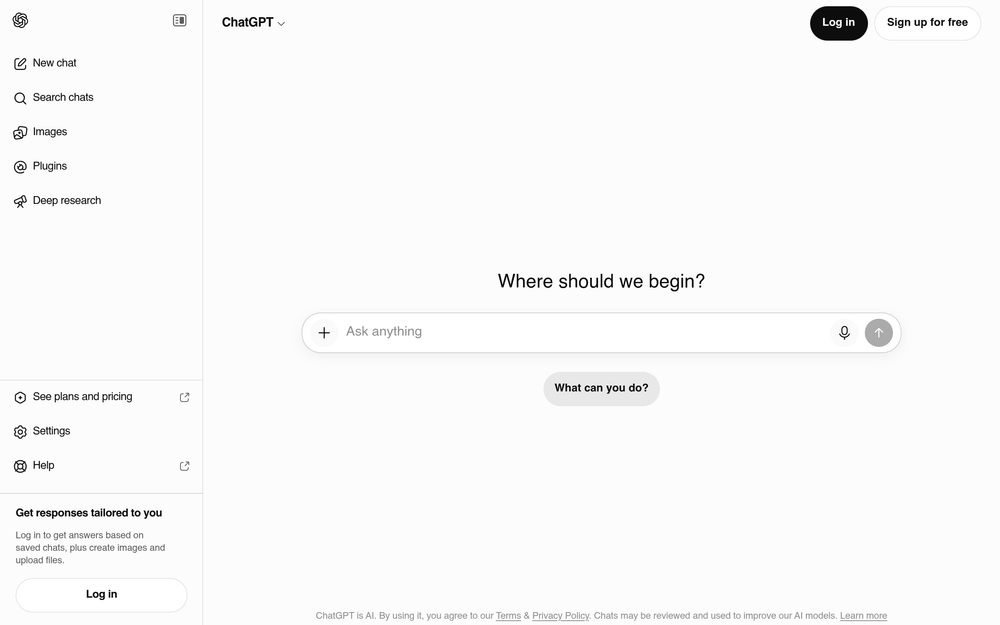
ChatGPT is an AI assistant platform developed by OpenAI, designed to facilitate a wide range of text-based tasks through conversational interaction. It enables users to generate, refine, and analyze content by engaging in natural language dialogues, making it a versatile tool for both personal and professional use. The platform is built on advanced generative AI models, which allow it to produce coherent and contextually relevant responses across various topics.
As a text-focused AI tool, ChatGPT fits into the broader landscape of AI writing assistants and generative AI applications. It serves as a general-purpose assistant that can help with drafting emails, writing essays, brainstorming ideas, summarizing documents, and even coding. Its accessibility through a web interface and mobile apps makes it a convenient choice for individuals and teams seeking an AI-powered productivity boost.
Best for
- Writers and content creators needing assistance with drafting, editing, and brainstorming.
- Students and researchers looking for help with summarizing, paraphrasing, and generating ideas.
- Professionals who require quick answers to questions or help with composing business communications.
- Developers and programmers seeking assistance with code snippets, debugging, and explaining technical concepts.
- Anyone interested in exploring generative AI for everyday tasks, from planning to learning.
Key capabilities
- Conversational text generation: Produces human-like responses based on user prompts, enabling interactive dialogue.
- Multi-turn context handling: Maintains context across a conversation, allowing for follow-up questions and iterative refinement.
- Broad knowledge base: Trained on a diverse range of internet text, enabling responses on many topics.
- Language understanding and generation: Supports multiple languages, though performance may vary.
- Custom instructions: Users can set preferences for tone, style, and other parameters to tailor responses.
- File upload support: Allows users to upload files (e.g., PDFs, Word docs) for analysis and summarization (feature availability may vary).
Common workflows
- Drafting and refining written content: Users ask ChatGPT to write a first draft of an email, blog post, or report, then iteratively refine it by requesting changes in tone, length, or structure.
- Brainstorming and ideation: Users prompt ChatGPT to generate lists of ideas, such as blog topics, product names, or solutions to a problem, then discuss and narrow down options.
- Summarizing and extracting information: Users paste a long article or document and ask for a concise summary, key points, or a bulleted list of main takeaways.
- Learning and explanation: Users ask ChatGPT to explain a concept in simple terms, provide examples, or quiz them on a topic to aid understanding.
- Code assistance: Users request code snippets, debugging help, or explanations of programming concepts, using the conversational interface to iterate on solutions.
What to evaluate
- Model access and performance: Consider which underlying model is available to you and how it affects response quality and speed.
- Output quality and accuracy: Assess whether the generated content meets your standards for correctness and relevance, and be prepared to fact-check.
- Source transparency: Understand that ChatGPT does not always cite sources, so verify critical information independently.
- Privacy and data handling: Review how your conversations are stored and used, especially if you input sensitive or proprietary information.
- Integrations and export options: Check whether ChatGPT integrates with your existing tools (e.g., via API) and how easy it is to export or share your conversations.
- Human review: Recognize that AI-generated content may require human editing and oversight, particularly for professional or academic use.
Getting started
- Visit the official ChatGPT website at https://chatgpt.com and create an account or log in.
- Familiarize yourself with the interface: type a prompt in the chat box and observe the response.
- Experiment with different prompts and use the feedback options (like or dislike) to refine future responses.
Why ToolSift lists it
ChatGPT is listed under the AI and Text categories because it is a leading example of generative AI applied to text-based tasks. Its tags—Artificial Intelligence, Generative AI, Writing Tools, and AI Assistants—reflect its core functionality as an AI-powered writing and assistance tool. The official URL (https://chatgpt.com) was verified as the canonical source for the product. For more information, visit ChatGPT.


